
With a smart home battery and a dynamic energy contract, it is possible to trade electricity. By automatically storing electricity during surpluses and supplying it during shortages, you can earn returns while simultaneously helping to make the power grid more sustainable and balanced.
Do you want to trade electricity smartly with your home battery? Then let the system be controlled by NextEnergy. You can choose from Self-consumption, Self-consumption Plus, and Imbalance Market. We take into account the household’s needs combined with what is happening in real-time on various energy markets. Our smart control automatically selects the best strategy for your situation every minute.
Find more information on our home battery page and start your consultation.
How You Earn Back
Your home battery has two ways to save you money: by trading smartly on the market and by using electricity more efficiently at home. Both contribute, but you will see them reflected in different places in the app and on your bills.
Trading Result: What Happens on the Market
Your battery doesn’t just look at the electricity prices in your app — those are the prices on the EPEX market, the daily energy exchange — but also at the imbalance market and the intraday market. It sounds complicated, but the idea is simple: these are markets where grid operators and energy companies trade to keep supply and demand balanced. And your battery responds smartly to that.
For example: the exchange price is low and you would expect the battery to charge. But somewhere in the Netherlands there is a shortage of electricity on the imbalance market at that moment. Then your battery may still feed electricity back — because that is more valuable at that time. A little later there is a surplus of electricity, and your battery charges again. This can happen multiple times a day, with our software reassessing each time.
That is also exactly why you don’t have to manage the battery yourself. The system continuously — not just once a day, but every minute — looks for where your battery can add the most value. Sometimes that is by supplying energy back to the grid. Sometimes by charging and waiting for a better moment.
Every time a trade happens, you see that reflected in your trading result. This appears one day later in the NextEnergy app, as soon as the imbalance prices have been determined and the consumption data from your smart meter has been received. The trading result is also on your Battery Compensation Invoice — because these are actual transactions: electricity bought or sold on the market.
Savings: What Happens at Home
Besides the trading result, your battery also saves on your daily energy bill. This works differently than trading, but the effect on your wallet is just as real.
The battery continuously monitors current electricity prices. And just as you may already be used to from a dynamic energy contract: at one moment electricity is very cheap, at another moment significantly more expensive. Your battery responds smartly to this. It charges when electricity is cheap — for example, during the day when your solar panels are producing abundantly, or during a low-price period on the exchange. And discharges when prices are higher, so you need to buy less expensive electricity from the grid.
Do you have solar panels? Then the battery also ensures that you use more of your own generated electricity at home. Without a battery, a large part of your solar energy goes back to the grid — often for little return. With a battery, you store that surplus and use it yourself later. That directly reduces your monthly costs.
You won’t see this as a separate line item on your bill. Savings are not an amount you receive — it’s money you don’t have to spend. You notice it because your average delivery price decreases and you pay less monthly. Sometimes you will see positive and negative numbers in your savings in the app. That is normal: the battery makes the smartest choices every day, and sometimes a day turns out differently than expected.
How Do We Calculate the Yield?
To calculate the yield of your battery, we compare two situations: how your day actually went with the battery, and how that same day would have looked without it.
We look at two scenarios:
With battery: this is what really happened. Your home used electricity, bought electricity from the grid, and sometimes fed electricity back via the battery.
Without battery: we recalculate that same day as if the battery had not been there. Same consumption, same prices — just without the smart charging and discharging moments.
The difference between these two situations is the financial yield of your home battery. Split into trading result (what was earned on the market) and savings (what you saved at home). This way you know exactly what your battery has done for you each day.
Want to know more about how the invoices are structured? Then check out our explanation about the Battery Compensation Invoice.
What Does the Savings Outcome Mean?
Your battery saves money by storing electricity at smart moments and using or supplying it later to the grid. We calculate daily what the battery has financially yielded. Do you see a negative number? That’s good news — it means your battery has prevented costs.
Think of it as a discount on your energy bill. -€3 simply means: you paid €3 less than you would have without the battery.
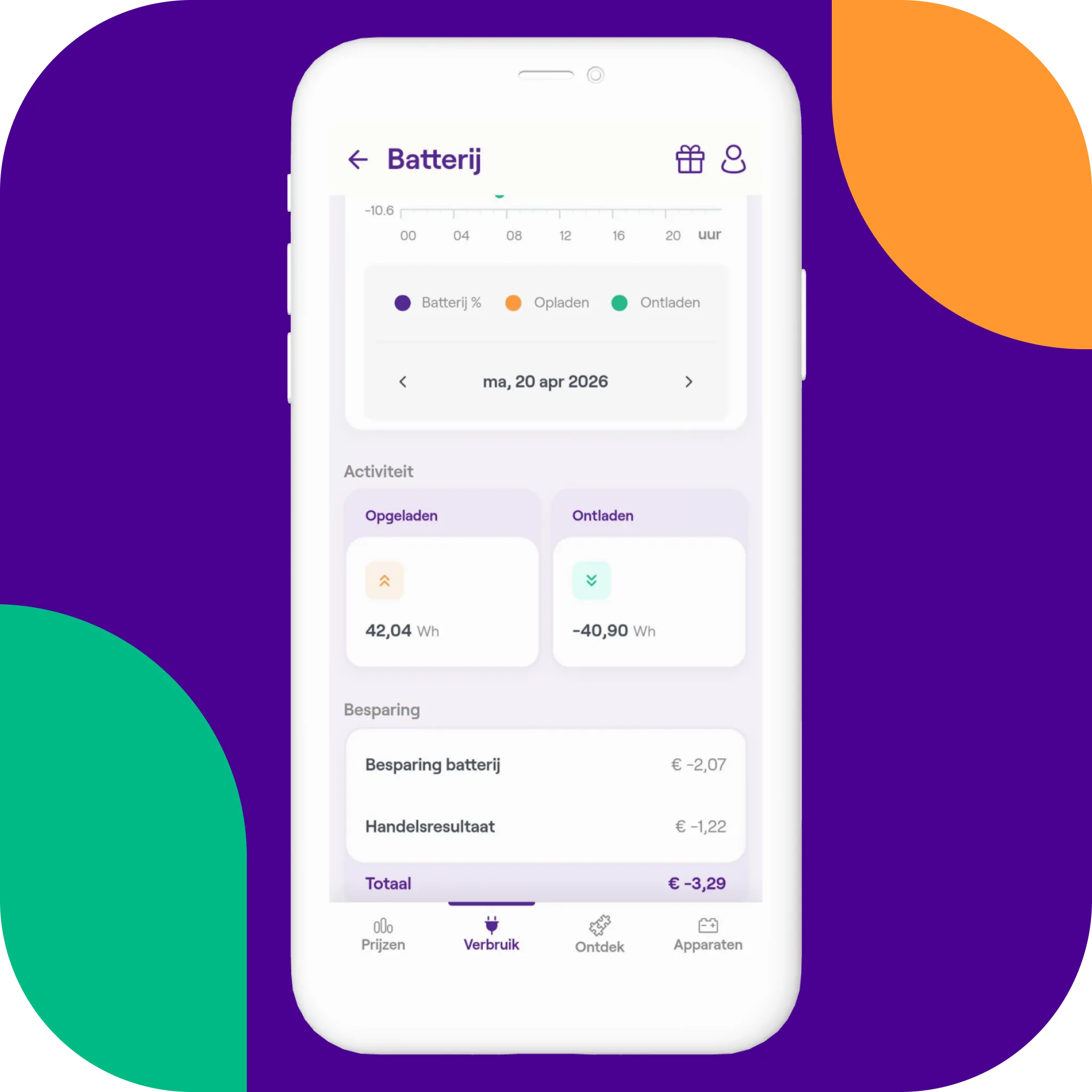
Why Do I Sometimes See Costs on a Day I Expected to Earn?
This is a question we often get, and the answer lies in how the battery thinks. Your battery doesn’t look at days, but at moments. So it can happen that the battery charges today — and you pay for that — to use that energy tomorrow at a moment that yields more.
What makes it sometimes hard to follow: trading and saving run together. A day when your battery incurs costs can feel like something is wrong. But often the battery is actually preparing for the next step. It charges because that is the smartest choice at that moment — and uses that energy later when it yields more.
The profit is therefore not in one day, but in the total over multiple days. That is exactly how smart control works.
The Benefits of Trading Electricity
Trading electricity offers more than just financial opportunities. It also helps keep the energy grid balanced and more sustainable. We explain more about these benefits below.
1. Achieve Returns
By trading electricity on the imbalance market, you can achieve returns. You use your battery for trading on the energy market and capture high returns. Of course, you can also use the electricity stored in your battery yourself, depending on the software.
2. Stabilize the Energy Grid
Home batteries can help keep the energy grid stable. By storing electricity when there is too much and supplying it back during shortages, you ease the pressure on the grid. This is important as more and more households use solar panels, heat pumps, and electric cars.
3. Make the Energy Grid More Sustainable
Finally, you help make the energy grid more sustainable. During a surplus of electricity, there is often a lot of green energy available. When you charge your home battery at these times and discharge when there is too little supply, you increase the use of green electricity and reduce the need for fossil backup power plants.
Comments
0 comments
Article is closed for comments.